How Smart AI-Powered Toys Are Blending Gaming, Learning, and Play
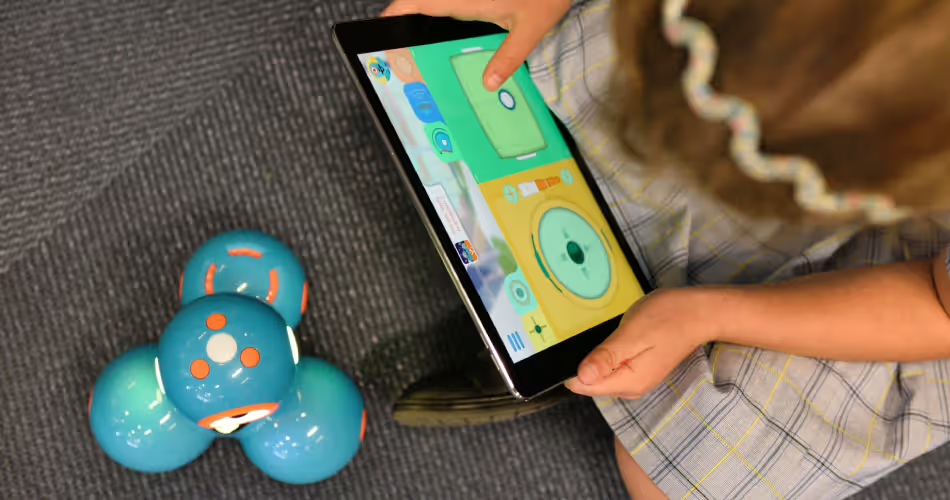
Toys powered by artificial intelligence provide learning through video games and interactive play. They change the way children experience play by providing a lot of fun and important development through customizing your involvement, giving you more opportunities to interact with others, and making education enjoyable.
As smart AI toys change how we view engaging activities, we are moving toward a greater reliance on technology for playful enjoyment of our everyday lives, as we have become accustomed to being distracted by our mobile devices (phones and tablets) from having fun. Smart toys differ from traditional toys, such as plastic action figures or wind-up robots, because they are a child's interactive companion that adapts to the child as he or she grows and learns. They also create a new definition of play by integrating real-world skill development with education, play, and fun, resulting in a new type of activity that allows us to learn through exploration.
Am I correct in saying that there are specific criteria for a toy being considered "smart"? The foundation of these toys is artificial intelligence, the same technology that makes voice applications possible, allows Netflix to suggest movies to watch, and helps undergird many of the autonomous cars on our roads today. However, the primary way AI is incorporated into a toy is by allowing the toys to listen to you, respond to you, and interact with you in a way that feels natural, rather than just organizing your calendar or showing you the latest set of recommended songs when you ask for them. Thus, if you have a toy that recognizes your voice, remembers your preferences, and modifies its behavior based on your individual play style, you are engaging in a truly personalized playing experience with your toys.
A significant part of why the toys are so popular is that they can easily blend and mix entertainment with learning, while traditional resources are perceived as more 'school-like' in nature. The use of smart toys provides children with opportunities to learn naturally. Much like how AI-powered NPCs help guide a player through quests in a game, a robot companion uses 'quest-like' things to teach programming concepts, and a plush companion uses conversations to help children learn vocabulary, storytelling, and emotional cues. Children may not even realize they are developing essential skills as they laugh, explore, and complete puzzles together. In addition, artificial intelligence can quickly and easily adjust the difficulty levels to each child's individual pace, ensuring that no child stops growing or does poorly because they are upset.
Gaming elements are also a major component of your smart toy. Many smart toys feature gaming elements, including objectives, rewards, and continuous feedback. As a result, children can score points, unlock new animations, and break their best scores to keep them excited and motivated to continue learning. Smart toys can even fill the role of regular playmates that children can check in with, interact with daily, and build a bond with. They are more than just temporary learning tools.
Social aspects of the play have also been enhanced, where smart toys often connect to networks or applications that allow children to share their creations, compare progress, and collaborate on challenges, thereby extending the experience beyond just the product, changing it into much more than that with many children involved. Parents also engage in the process by tracking or customizing their child's development through these toys, transforming leisure time into a community experience rather than individual ones.
Arguably, the development of AI-enabled devices as they learn from their users is even more interesting than the development of social play. These will no longer be objects used until boredom sets in, then put away; rather, they will resemble, to some degree, living companions due to the devices' intelligence and their ability to generate new ideas and change their form. This form of interaction offers new opportunities to learn by observing how a child interacts with the device.
Psychologists and educators are excited by the prospects of such innovations; in effect, smart toys create an opportunity for enhancing human interaction and traditional education through the connection of creativity with understanding. As such, the use of smart toys will provide both the home and the classroom with an opportunity to redefine play, enhancing learning and growth without feeling like they are in a formal educational environment.
The latest AI-enhanced toys have completely shifted the paradigm of toys to a brand new form of play—the era of combined fun and development through high-intensity competitive video gaming, personalized learning experiences, and lively interaction with each other.